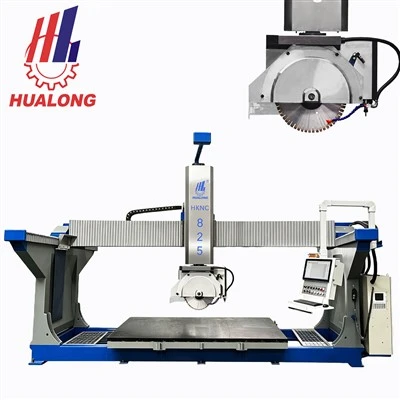
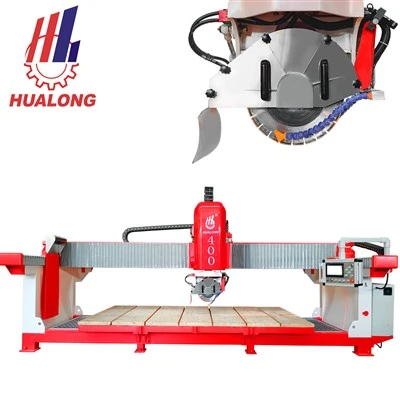
The core evaluation criteria for selecting bridge cutting machine parameters should focus on actual production results, rather than simply listing basic functions, to accurately identify high-performance equipment suitable for mass production conditions. The following six key specifications directly determine the production stability, finished product accuracy, and overall output efficiency of granite bridge cutting machines.
I. Machine Structure and Rigidity
A high-rigidity, structurally stable machine frame is the core foundation for the long-term stable operation of the equipment. It ensures that the equipment maintains consistent operating conditions under continuous heavy-load cutting conditions, effectively suppressing deformation deviations caused by long-term continuous production, and guaranteeing the uniformity of accuracy in batch processing from a hardware perspective. The structural advantages of three-axis bridge cutting machines are also fully reflected in this dimension.
II. CNC and Interpolation Performance
The computational accuracy and response performance of the CNC control system directly determine the smoothness of the cutting trajectory, the transition accuracy of process connections, and the repeatability stability of cutting irregular and complex patterns. It is the core electrical control component for controlling the finished product cutting accuracy and achieving standardized mass production.
III. Spindle and Saw Blade Compatibility
Precisely matching the spindle output power with saw blade specifications to suit different granite hardness and slab thickness ranges significantly improves the stability of the cutting process, effectively reduces saw blade wear and extends tool life, while avoiding issues such as vibration and edge chipping, ensuring consistent cutting quality.
IV. Feed Stability and Repeatability
The stability and repeatability of the equipment's feed operation directly affect the finished product's cutting effect. If the feed operation is choppy, the speed fluctuates, or the positioning deviation is large, it can easily cause uneven edges, dimensional deviations, and other defects in the cut slab, leading to product rework, material waste, and directly reducing overall production capacity and yield.
V. Cooling and Chip Removal Performance
An efficient cooling water supply system and a comprehensive chip removal mechanism can cool and dissipate heat from the high-speed rotating saw blade in real time and promptly remove cutting chips, effectively preventing saw blade overheating and deformation, saw jamming and wear. This ensures a consistently smooth and clean cut surface, reduces dust and debris accumulation on the equipment, lowers the probability of failure, and reduces the frequency of daily maintenance.
VI. Safety and Operational Performance
The safety protection design and the rationality of the disassembly and maintenance structure of the equipment directly affect the continuity of production. Models with convenient operation and maintenance and comprehensive safety protection can significantly shorten downtime for troubleshooting and parts replacement, reduce non-production time, ensure the continuous and stable operation of the production line, and solidify the foundation for mass production capacity.