Introduction
For stone processors, reducing material waste during stone block cutting directly affects how much saleable stone can be produced from every expensive raw block. Material loss does not come only from visible off-cuts, but also from kerf loss, slab breakage, dimensional errors, and rework caused by inaccurate cutting. Improving stone yield therefore requires a combination of narrow-kerf cutting, precise CNC control, efficient slab utilization, and appropriate waste recovery systems.
Where Does Material Waste Occur During Stone Block Cutting
Material waste can enter the production process at several different stages, so reducing it requires more than simply changing the cutting tool. Buyers should first identify where usable stone is being lost and then match the cutting technology to each source of waste.
Kerf Loss
Every cutting operation removes a certain amount of material as kerf, and the cumulative loss becomes significant when processing large stone blocks into multiple slabs. A narrower cutting kerf can retain more material between individual slabs and improve overall block utilization.
Slab Breakage & Thickness Variation
Cracks, excessive vibration, inaccurate positioning, or inconsistent cutting can produce damaged or non-conforming slabs that cannot enter the next processing stage. Preventing these defects helps reduce both direct material loss and the additional waste created by re-cutting or reworking.
How Can Narrow Kerf Cutting Improve Stone Block Yield
The cutting width between adjacent slabs is one of the most direct factors affecting material utilization during primary block processing. Multi-wire technology addresses this issue by using multiple diamond wires simultaneously while maintaining a narrow kerf, allowing more usable slabs to be obtained from the same block.
The HLMW-100/150 Ultra-Thin Multi Wire Saw uses adjustable 0.3–0.8 mm diamond wires and can process multiple slabs in a single pass, with a focus on reducing kerf loss and improving block utilization. Its 5–30 mm slab capability and narrow-kerf design make it particularly relevant to production involving thin slabs and high-value stones where every millimeter of raw material matters.

How Can CNC Sawjet Cutting Reduce Slab Off-Cuts
Material efficiency remains important after the stone block has been converted into slabs, particularly when manufacturers produce countertops, sinks, bevels, or irregular architectural components. Combining saw cutting with waterjet cutting gives processors more flexibility to select an efficient cutting method for both straightforward and complex geometries.
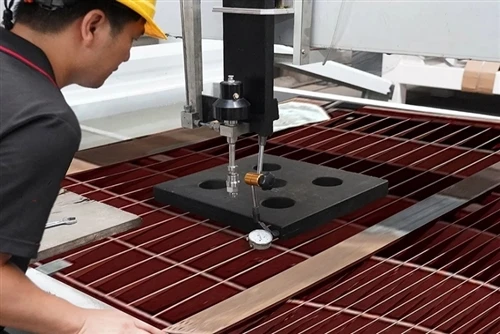
The HKNC-450J 5-Axis CNC Sawjet combines a 5-axis bridge saw with a five-axis CNC waterjet, allowing the saw to handle efficient straight, circular, and bevel cuts while the waterjet handles finer shapes, arcs, flutes, and small angles. Its CNC transmission system uses linear ball guides, servo motors, and high-precision helical gears and racks, while DXF files can be imported for programmed cutting, supporting more accurate layouts and reducing unnecessary material loss. Get more information about how to reduce material waste by The HKNC-450J 5-Axis CNC Sawjet in our article: Why Invest in a Hualong Sawjet? – Higher Efficiency, Lower Cost & Faster ROI.

How Does Cutting Precision Prevent Hidden Material Loss
Material waste is not always visible as discarded stone, because dimensional errors, uneven cutting, and rejected components can consume additional material through rework. High-precision CNC motion and positioning help maintain consistent cutting paths, while suitable control and sensing systems reduce the risk of avoidable cutting deviations.
|
Equipment / Feature |
Technical Parameter |
Value / Reference |
|
HKNC-450J 5-Axis CNC Sawjet |
Saw Blade Diameter |
Ø350–650 mm |
|
Maximum Cutting Thickness |
190 mm |
|
|
Saw Blade Motor Power |
15 kW |
|
|
HLWJ-4020 5-Axis CNC Waterjet |
Cutting Accuracy |
±0.1 mm |
|
Repeatability |
±0.05 mm |
|
|
Angle Cutting Accuracy |
±0.1° |
|
|
A-Axis Swing |
±60° |
The specifications show that precision varies by machine and application, so buyers should evaluate the actual accuracy requirement against the equipment model rather than applying one accuracy figure across an entire stone machinery range.
How Can Stone Waste and Water Be Reused
A complete waste-reduction strategy should also consider what happens to stone residues and process water after cutting. Recovery systems can reduce the amount of material and water treated as disposable waste while helping processors build a more resource-efficient production workflow.
Recover Usable Stone Residues
Larger stone off-cuts can sometimes be separated according to size, material type, and potential downstream application instead of being immediately discarded. A stone crushing machine can support the crushing and further handling of suitable stone waste for downstream reuse.
Recycle Process Water
Stone cutting generates slurry and wastewater containing suspended stone particles, making water management an important part of an efficient processing plant. Water curtain dust collectors, eco water recycle systems, and wastewater filter press systems can be integrated into stone-processing workflows to support dust control, water recovery, and wastewater treatment.
How Should Stone Processors Choose Equipment to Reduce Waste
The right equipment should be selected according to where material loss occurs rather than based only on machine output or purchase price. Hualong offers equipment across block cutting, multi-wire sawing, CNC bridge cutting, sawjet processing, waterjet cutting, stone processing, crushing, and dust and water recycling, allowing buyers to evaluate individual machines as part of a broader production workflow.
For Primary Block Processing
Choose a multi wire saw or multi blade block cutter when the main objective is to maximize the number of usable slabs obtained from each block. Buyers should compare kerf width, target slab thickness, block dimensions, cutting capacity, and the characteristics of the stone being processed.
For Slab Fabrication
Choose a CNC bridge saw or sawjet when secondary cutting involves countertops, sinks, bevels, curves, or other complex geometries. Cutting accuracy, axis configuration, software compatibility, and the ability to execute different cutting methods should be considered alongside basic cutting speed.
For Integrated Production
Consider combining cutting equipment with processing and recycling systems when material loss occurs across several stages of production. An integrated approach can connect primary cutting, precision fabrication, stone waste handling, and water treatment instead of optimizing each process in isolation.


Conclusion
Reducing material waste during stone block cutting is ultimately about converting a greater percentage of every raw block into usable, saleable stone. Narrow-kerf multi-wire cutting, precise CNC processing, flexible sawjet technology, and waste-recovery systems can address different sources of loss throughout the production process. Contact our engineering team to discuss your stone type, block size, target slab thickness, and production requirements and develop a stone cutting solution focused on higher material utilization.