Introduction
A bridge saw cuts stone through the coordinated work of blade motion, spindle power, positioning control, and cooling support. For businesses involved in slab cutting and stone fabrication, understanding how these systems work together makes it easier to evaluate bridge saw performance in practical terms.

What Happens When a Bridge Saw Starts Cutting Stone
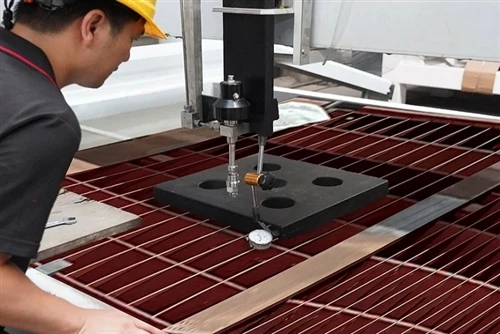
When a bridge saw starts cutting stone, the process begins with the slab being positioned securely on the worktable while the blade is brought into a controlled cutting path. As the spindle drives the blade at high speed, the machine moves the cutting head, or bridge structure, along a planned path so the blade can remove material gradually and consistently. At the same time, positioning control, feed stability, and cooling support help keep the cut accurate, smooth, and suitable for stone fabrication tasks such as slab processing and countertop preparation.
Which Core Systems Make the Cutting Process Work
A bridge saw cuts stone through the coordination of several machine systems rather than through blade rotation alone. In practical slab cutting and stone fabrication, the cutting result is shaped most directly by four core systems working together:
- Blade, Spindle, and Motor System: This system provides the cutting force that allows the blade to enter the stone in a stable and controlled way. Its performance directly affects cutting continuity, efficiency, and the machine`s ability to handle different stone materials.
- Bridge Structure, Gantry, and Rails: The structural system supports the movement path of the cutting head and helps maintain mechanical stability during operation. A stronger bridge and rail system usually contributes to smoother travel and more consistent cutting performance.
- Positioning and Control System: This system determines how accurately the machine follows the intended cutting path. It helps the bridge saw maintain alignment, coordinate movement, and support more precise slab cutting or detail-oriented fabrication tasks.
- Cooling and Lubrication Support: Cooling support helps manage heat during cutting, while lubrication helps key moving parts operate more smoothly over time. Together, they support cutting stability, machine durability, and more reliable day-to-day operation.
Why Does Movement Control Matter So Much in Bridge Saw Cutting
Movement control matters so much in bandsaw cutting because cutting quality depends not only on blade power but also on how accurately and consistently the machine follows its intended path. In slab processing and countertop fabrication, better control usually means more stable cutting behavior, cleaner edge results, and more predictable performance across different processing tasks:
|
Control Function |
Cutting Benefit |
Result in Fabrication |
|
Straightness and Repeatability |
Helps the blade follow a more stable and consistent cutting path across repeated operations |
Supports cleaner slab cutting and more uniform results in batch fabrication |
|
Angle Control and Miter Cutting |
Allows the machine to manage cutting direction more precisely for angled processing needs |
Supports miter cutting and more flexible fabrication requirements |
|
Alignment for Irregular or Detailed Cuts |
Helps the blade stay coordinated with more specific cutting layouts and processing paths |
Improves fitting accuracy in countertop and detail-oriented fabrication |
|
Control Over Finish Quality and Material Use |
Makes cutting behavior more predictable during processing |
Contributes to cleaner edge quality and more efficient material use |
How Does a Bridge Saw Support Different Stone Materials and Applications
A bridge saw supports different stone materials and applications by combining a stable machine structure, controlled blade movement, and adaptable cutting coordination within one system. Its working principle remains consistent, but the way that principle creates value becomes clearer when material characteristics and fabrication tasks are considered separately.
Bridge Saw Performance Across Different Stone Materials
Although a bridge saw follows the same core cutting logic across stone fabrication, its practical value becomes more visible when different material types are considered within real processing conditions:
- Granite Processing: Granite is often associated with harder cutting conditions, so bridge saw stability helps maintain a more controlled cutting path and more consistent slab processing performance.
- Marble Processing: Marble fabrication usually places greater emphasis on smoother cutting behavior and cleaner surface-oriented results, which makes movement stability and cutting consistency especially valuable.
- Quartz Slab Processing: Quartz slabs require predictable cutting coordination in engineered stone fabrication, so a stable bridge saw system helps support repeatable cutting results across daily production tasks.
Bridge Saw Use in Slab Cutting and Countertop Fabrication
In practical stone fabrication, bridge saws are commonly used first for slab cutting, where the goal is to create straight, stable, and repeatable cuts that prepare the material for downstream processing. From there, the same bridge saw system can also support countertop fabrication, where cutting consistency becomes even more important because later fitting, edging, and installation steps depend on dimensional accuracy and cleaner processing results.
What Should Buyers Learn from the Cutting Principle
What buyers should learn from the cutting principle is that bridge saw performance cannot be judged by blade size or machine appearance alone. A more useful reading comes from understanding how structural stability, spindle output, movement control, and application adaptability work together to shape real cutting results. For buyers comparing machines for slab cutting, countertop fabrication, or broader stone processing, this makes it easier to evaluate whether a bridge saw from an experienced manufacturer, such as Hualong, is likely to deliver the level of precision, consistency, and workflow fit the business actually needs.
Conclusion
A bridge saw cuts stone through the coordinated work of structural stability, spindle power, movement control, and process support rather than blade motion alone. For buyers and fabricators, understanding this cutting principle makes bridge saw performance easier to evaluate in relation to real stone materials, fabrication tasks, and production needs. Contact us to find the relevant bridge saw and stone processing solution for your business.