Introduction
Bridge saw performance depends not only on the machine's structure but also on how consistently the equipment is maintained during daily production. Regular cleaning, lubrication, cooling system care, and calibration all help support smoother cutting operations and longer service life.
Why Maintenance Planning Matters for Bridge Saw Operations
Bridge saws are widely used in continuous stone fabrication environments where stable machine movement and cutting consistency are important for daily production efficiency. Because granite, marble, and quartz processing generate large amounts of dust, slurry, and moisture, maintenance planning becomes part of long-term equipment management rather than an occasional task.
Well-organized maintenance routines help support smoother bridge travel, cleaner cutting performance, and more stable positioning accuracy. They also help maintain cleaner operating conditions around transmission systems, cooling structures, and CNC movement components in modern stone-processing equipment.
Which Machine Areas Should Be Checked During Daily Bridge Saw Maintenance
Daily inspection routines usually focus on the machine areas most exposed to dust, water, and repetitive movement. Keeping these sections clean helps support smoother machine operation over time.
Working Table & Stone Debris Areas
Stone powder, slurry, and cutting residue should be removed from the working table and surrounding machine surfaces after each shift. Cleaning these areas regularly helps maintain a cleaner production environment and reduces buildup around moving structures.
Operators should also pay attention to machine corners and hidden accumulation zones where fine debris may collect during large slab cutting operations.
Guide Rails & Rack Systems
Guide rails and rack systems support the movement accuracy of the bridge structure. Wiping rail surfaces and rack areas helps maintain smoother beam travel during repeated cutting cycles.
For CNC bridge saw machines, clean movement systems also contribute to more stable positioning performance during automatic cutting operations.
Electrical Cabinet Environment
Electrical cabinets should remain dry, sealed, and free from excessive dust accumulation. Periodic internal cleaning helps maintain cleaner operating conditions for electrical control systems.
In stone fabrication workshops where water circulation systems operate continuously, maintaining a protected cabinet environment supports long-term electrical stability.
How Lubrication and Cooling Systems Support Long-Term Cutting Stability
Lubrication and cooling systems directly influence machine movement smoothness and blade operating conditions. Consistent maintenance routines help support long-term cutting stability across different stone-processing applications.
Lubricating Moving Components Regularly
The guide rails, ball screws, and gear-related components on the X, Y, and Z axes should receive regular lubrication according to production frequency. Proper lubrication helps maintain smoother mechanical movement and supports long-term positioning accuracy.
Operators should also inspect oil levels periodically and monitor lubrication conditions around transmission structures and moving assemblies.
|
Maintenance Area |
Main Focus |
Suggested Frequency |
|
Guide Rails |
Surface Cleaning & Lubrication |
Weekly |
|
Ball Screws |
Lubrication Condition |
Weekly |
|
Cooling Nozzles |
Water Flow Cleaning |
Weekly |
|
Water Tank |
Slurry Sediment Cleaning |
Biweekly |
|
Gear Oil |
Oil Level Inspection |
Monthly |
|
Electrical Cabinet |
Dust Removal |
Monthly |
Maintaining Stable Cooling Water Circulation
Cooling water systems help maintain stable blade temperatures during stone-cutting operations. Water flow should remain sufficient and evenly distributed throughout the cutting process.
Operators should regularly clean spray nozzles, water pipes, and filter areas to support stable circulation performance. For recycling water systems, periodic sediment cleaning inside the water tank helps maintain cleaner water flow conditions.
What Mechanical Components and Cutting Systems Should Be Regularly Inspected
Routine inspection helps maintain cutting consistency and supports stable machine operation across long-term production cycles.
Monitoring Blade Condition
Blade surfaces should be visually checked before production shifts begin. Operators typically observe wear consistency, segment condition, and overall blade stability during routine inspection.
Maintaining blades in a stable operating condition supports cleaner cutting quality and more consistent processing results for granite and marble applications.
Checking Belt Tension & Structural Connections
Transmission belts should maintain balanced tension to support stable power transfer during cutting operations. Operators should also inspect fastening points around the motor base, bridge structure, and cutting head assembly.
Periodic structural checks help maintain machine stability during continuous production environments.
Performing Routine Accuracy Calibration
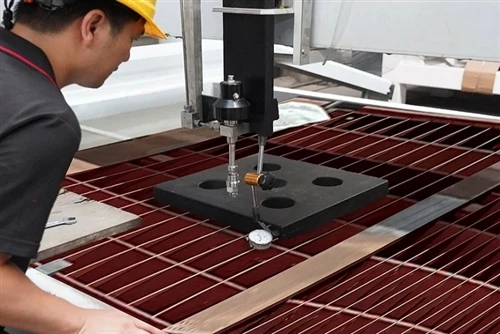
Regular calibration helps maintain cutting precision for straight and square cuts, as well as for large-slab processing applications. Many workshops use standard test blocks to check vertical alignment and diagonal accuracy during routine inspection schedules.
For automatic bridge saws and CNC bridge saw systems, stable calibration supports more consistent digital positioning performance.
Which Bridge Saw Features Help Simplify Long-Term Maintenance
Some bridge saw designs are easier to maintain because maintenance accessibility is considered during machine development. Organized machine layouts and accessible service areas help operators perform routine inspection, lubrication, and cleaning more efficiently during long-term stone processing operations.
- Accessible Lubrication & Maintenance Areas: Bridge saw machines with centralized lubrication points and accessible guide rail layouts help simplify routine servicing work. Easy-access maintenance zones can also improve inspection efficiency during daily maintenance schedules.
- Organized Cooling & Protective Structures: Structured water circulation layouts help operators clean water tanks, spray nozzles, and filtration areas more conveniently. Protective covers around transmission systems also help reduce dust exposure in high-volume stone fabrication environments.
- CNC Interfaces & Stable Machine Structures: In CNC bridge saw systems, organized control layouts and diagnostic interfaces help operators monitor machine operating conditions more efficiently. Stable bridge structures and well-planned machine layouts also support long-term maintenance convenience.
Experienced stone machinery manufacturers such as Hualong often consider maintenance accessibility as a part of long-term machine design.
What to Look for in a Maintenance-Supportive Bridge Saw Manufacturer
Bridge saw maintenance involves not only daily but also long-term technical support and machine structure planning. When evaluating a bridge saw manufacturer, buyers often review whether maintenance-related support is available throughout the equipment lifecycle.
- Spare Parts Availability: Stable spare parts supply helps maintenance teams manage routine servicing and replacement schedules more efficiently. Buyers often prefer manufacturers that can provide long-term support for key bridge saw components and consumable parts.
- Technical Support Responsiveness: Responsive technical support can help operators organize troubleshooting, maintenance planning, and operating adjustments more smoothly. Many stone fabrication workshops also value remote support capabilities for CNC bridge saw systems.
- Maintenance Documentation Support: Clear maintenance manuals, lubrication instructions, and inspection guidance help operators standardize daily servicing routines. Well-organized documentation also supports maintenance training for new machine operators.
- Machine Structure Accessibility: Machine layouts with accessible guide rails, lubrication points, and electrical structures help simplify routine maintenance work. Easy-access maintenance zones can also improve inspection efficiency during daily servicing schedules.
- Long-Term Equipment Stability: Many buyers evaluate whether a manufacturer focuses on stable machine structure, durable movement systems, and long-term operating consistency. For continuous stone fabrication environments, equipment stability remains an important part of maintenance planning.


Conclusion
Regular bridge saw maintenance supports smoother machine operation, more consistent cutting quality, and cleaner long-term production management. Well-planned cleaning, lubrication, cooling, and calibration routines all contribute to stable equipment performance across different stone-processing applications. Contact us for bridge saw maintenance recommendations based on your stone processing workflow.